

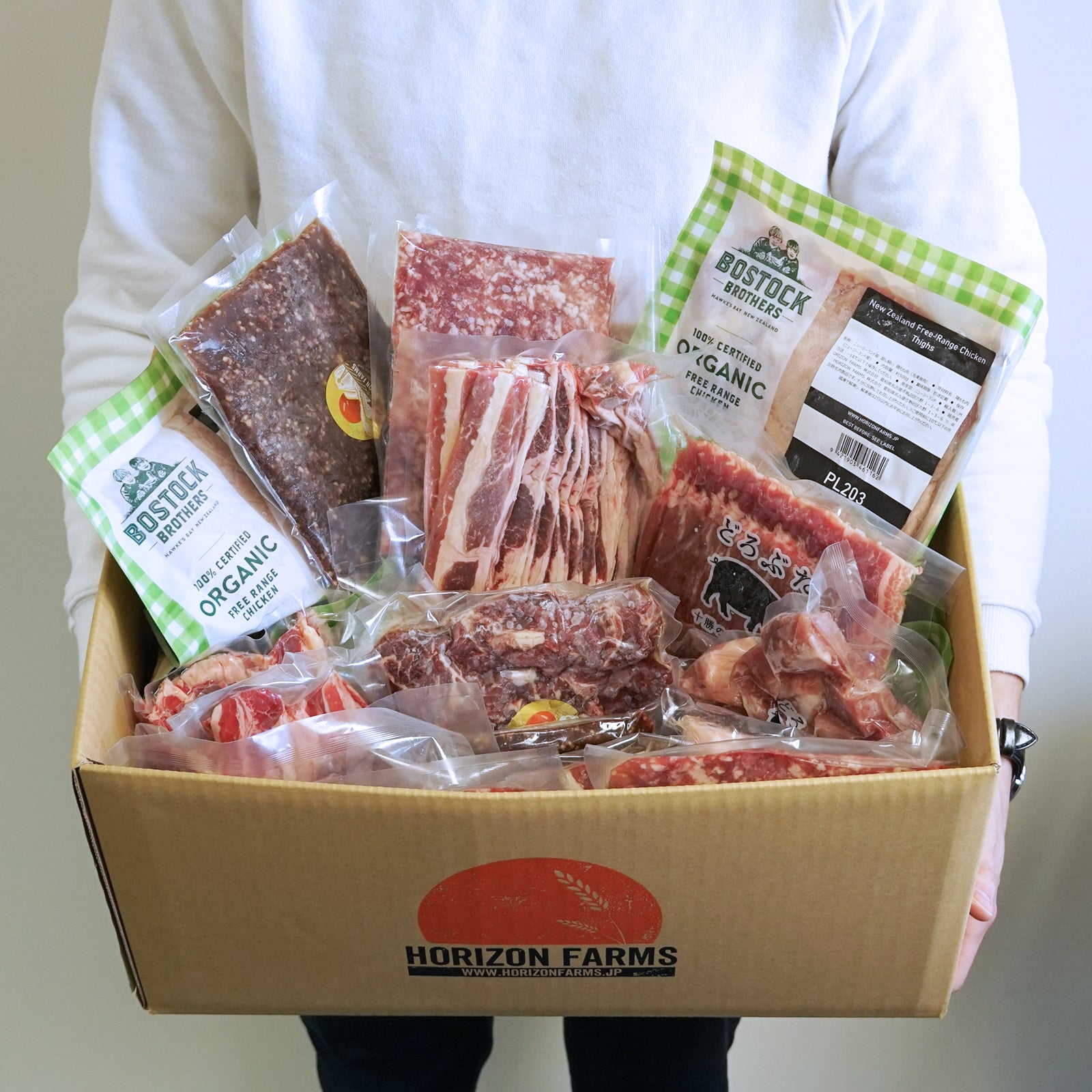

What’s in my food? This is a question you need to ask if you care, now more than ever. What are growth-promoting hormones? Are growth hormones dangerous? Quick research on this topic usually ends in frustration and leaves you even more confused than you were before. The issue itself is rather complicated and not as clear-cut as night and day. We will try to shed some light and hope to help widen your horizon by taking a look beyond it.
You can also click on the links below to jump right to the section you are interested in.
Why are growth hormones used in the first place?
Are growth-promoting hormones used on all farm animals?
Which countries allow the use of growth hormones?
Why is growth hormone-treated meat banned in the EU?
How is the situation in Japan?
Is meat from X country always treated with growth hormones?
Is meat from farm animals that have been treated with growth hormones labeled?
Is growth hormone-free meat more expensive?
Can meat contain growth hormone residues?
Are growth hormones a risk to human health?
Does organic farming allow the use of growth hormones?
Does 100% grass-fed mean “hormone-free”?
What about the animal's welfare?
What is the World Health Organization's stance on growth hormone use in farm animals?
What is Horizon Farms' stance on growth hormones on farm animals?
I am confused, so what is the right choice?
What are growth hormones?
First of all, it is important to note that hormones occur naturally in animals, plants, and humans -- yes, you produce hormones naturally. Naturally occurring hormones play an important role in development, growth, and reproduction. When it comes to livestock, we are referring to added growth hormones, also called “growth-promoting hormones,” used on farm animals. These hormones are a mix of natural and synthetic substances that promote the growth of young animals.1
Why are growth hormones used in the first place?
Growth hormones are used on farm animals for only one reason: faster weight gain. These hormones improve feed efficiency, allowing farm animals to be processed faster while yielding higher weights on the scale. At Horizon Farms, we only ever offer meat that is completely free of growth hormones and subtherapeutic antibiotics. 1
Are growth-promoting hormones used on all farm animals?
While it is technically possible to use growth-promoting hormones on any farm animal in form of feed, injections, or implantations, every country has different regulations and restrictions. The USA, for example, prohibits the use of growth hormones in poultry, while Canada prohibits the use of growth hormones in pigs. Both countries, however, allow the use of growth hormones on cattle. Nevertheless, we only source from farms that guarantee never having used any growth-promoting hormones or subtherapeutic antibiotics on their livestock.
Which countries allow the use of growth hormones?
As of writing this article, most leading export countries such as Australia, New Zealand, the USA, and Canada allow the use of growth hormones on meat and/or dairy cows. The EU has banned the use of growth hormones, as well as the import of meat from farm animals that have been treated with growth hormones.2
Please note that whether a country allows or bans the use of growth-promoting hormones is not the determining factor. It is solely a farmer’s decision whether to use growth hormones on their farm animals or not. As a result, all of the farms in our network commit to never having utilized growth hormones or subtherapeutic antibiotics on their livestock.
Why is growth hormone-treated meat banned in the EU?
The EU Scientific Committee on Veterinary Measures relating to Public Health (SCVPH) concluded that the use of growth hormones in beef production posed a potential health risk to humans. Since 1981, the EU has prohibited the use of substances with hormonal action for growth promotion in farm animals. This prohibition applies to all member states, as well as imports from third countries, and was confirmed again in 2003.2
How is the situation in Japan?
As of writing this article, the use of growth-hormones on farm animals is banned in Japan. Japan, however, allows the import and sale of meat from farm animals that have been treated with growth hormones. That being said, rest assured that all the meat we offer is free of growth hormones and subtherapeutic antibiotics. 3
Is meat from X country always treated with growth-hormones?
No. It is not a country’s decision to use growth hormones on farm animals, even if the country allows their use. It is solely a farmer’s decision whether to use growth hormones on their farm animals. Therefore, we choose to work only with farms that commit to never using growth-promoting hormones or subtherapeutic antibiotics on their livestock.
Is meat from farm animals that have been treated with growth hormones labeled?
There is no such regulation in Japan as of writing this article. Please ask the seller before making a purchase. You can expect meat from farm animals that have not been treated with growth hormones to be advertised as such, as it is considered an added value.
Is growth hormone-free meat more expensive?
Logically, yes. The reason for giving growth hormones to farm animals is to reduce costs and offer lower, more competitive prices. Growth hormone-free meat will always be more expensive.
Can meat contain growth hormone residues?
Strict government regulations require farm animals to go through a specified withdrawal period before being processed. At the time of processing, most growth hormones have already left the body, and only a small residue tolerance is allowed, which varies depending on each country’s regulations. If all rules and regulations are followed, meat from farm animals that have been treated with growth hormones is either free of residues or within the allowed tolerance. Nonetheless, at Horizon Farms, we are committed to offering only meat products from farm animals that have never been treated with growth hormones or subtherapeutic antibiotics.
Are growth hormones a risk to human health?
The effects are still unknown. Studies have been conducted that indicate that if growth hormones are administered correctly and the growth hormone-free period protocols before processing are followed, the levels of these hormones may be slightly higher in the meat, but still within the normal range of natural variation known to occur in meat from farm animals that have not been treated with growth hormones. 1, 4
Does organic farming allow the use of growth-hormones?
No. Organic standards do not allow growth-promoting hormones to be used on farm animals. 5
Does 100% grass-fed mean “hormone-free”?
No. 100% grass-fed cows and sheep can also be treated with growth hormones, and this is common in some countries where the practice is allowed. It is solely a farmer’s decision whether to use growth hormones on farm animals or not. Rest assured that all the meat we offer is free of growth hormones and subtherapeutic antibiotics.
What about the animal's welfare?
Growth hormones are used on farm animals for the sole purpose of increasing profitability. Generally, growth-promoting hormones are given to young farm animals, which means they grow faster than they normally would. There are several reports of animals showing abnormal behavior and physiological characteristics, which can be found online and in the media. Studies and internal audits have concluded that the misuse or incorrect handling of growth hormones was likely the main reason. With the aim of upholding animal welfare, we are dedicated to sourcing meat exclusively from farms that have refrained from administering growth hormones or subtherapeutic antibiotics to their livestock.
What about the environment?
Large meat processors and factory farms claim that the use of growth hormones helps farmers use less feed and allows farm animals to be processed faster, which in turn results in a smaller environmental footprint. Not using growth hormones to meet current world demand would mean that the number of farm animals would have to be increased to match the same output.
What is the World Health Organization's stance on growth hormone use in farm animals?
A joint FAO/WHO expert committee on growth hormone use in cattle concluded that “residues from use in accordance with good animal husbandry practice are unlikely to pose a hazard to human health” and that “although hormone levels found in treated animals were generally higher than levels in untreated ones, they were within the normal physiological range for these hormones in cattle.”
What is Horizon Farms' stance on growth hormones on farm animals?
Our philosophy is simple. We support farms that use traditional methods of animal husbandry and pay close attention to how the animals are treated throughout the whole process. Traditional family farming does not require farm animals to grow faster or at lower costs for higher profit. We guarantee that all our meat and dairy products come from farm animals that have never been given growth hormones or subtherapeutic antibiotics. Ever.
I am confused, so what is the right choice?
Like with any other food and health topic, it is too complicated to give a straight answer. There are too many players with many conflicts of interest. Large corporations that sell enormous quantities of factory-farmed meat have to satisfy shareholders by lowering costs and striving for higher profits. The consumer market demands cheap meat products more than ever. One of the pharmaceutical industry’s major buyers is the agricultural sector. Animal rights activists are on a mission to shift human diets away from animal proteins.
While the demand for natural and organic meat has been increasing over the years, small-scale farmers, who do not farm at maximum efficiency, find themselves competing in an unregulated market where the term “natural” means something different to each group. Governments are caught in the middle with diplomatic trade agreements and economic priorities.
Lobbying, the war of misinformation, lack of transparency, and protectionism all play a major role. We at Horizon Farms only offer meat products that come from animals that have never been treated with growth hormones or antibiotics, and products that are also all-natural and organic. That is our bias. We cater to health-conscious carnivores. Our mission and philosophy are firmly against the use of growth hormones on farm animals.
In the end, it is you who makes the decision: the consumer.
Disclaimer: Please note that while our explanations are correct, they have been simplified for brevity and easier understanding. We encourage you to do further research on this topic.
 |
About the author: Sam Tumeh, Founder and CEO of Horizon Farms, Inc., joined the consumer food and meat industry in Japan in 2010. |
Sources
1 https://www.canada.ca/en/health-canada/services/drugs-health-products/veterinary-drugs/factsheets-faq/hormonal-growth-promoters.html
2 https://sgp.fas.org/crs/row/R40449.pdf
3 https://trade.ec.europa.eu/doclib/docs/2017/july/tradoc_155716.pdf/
4 https://www.ncbi.nlm.nih.gov/pmc/articles/PMC3834504/
5 https://www.maff.go.jp/e/policies/standard/specific/attach/pdf/organic_JAS-12.pdf
1 comment
Chris
Thank you for providing a place where consumers can choose ethically raised and natural meats and products in Japan at reasonable prices (for the quality!). Great that you and your company are also educating consumers and wider community!
Thank you for providing a place where consumers can choose ethically raised and natural meats and products in Japan at reasonable prices (for the quality!). Great that you and your company are also educating consumers and wider community!